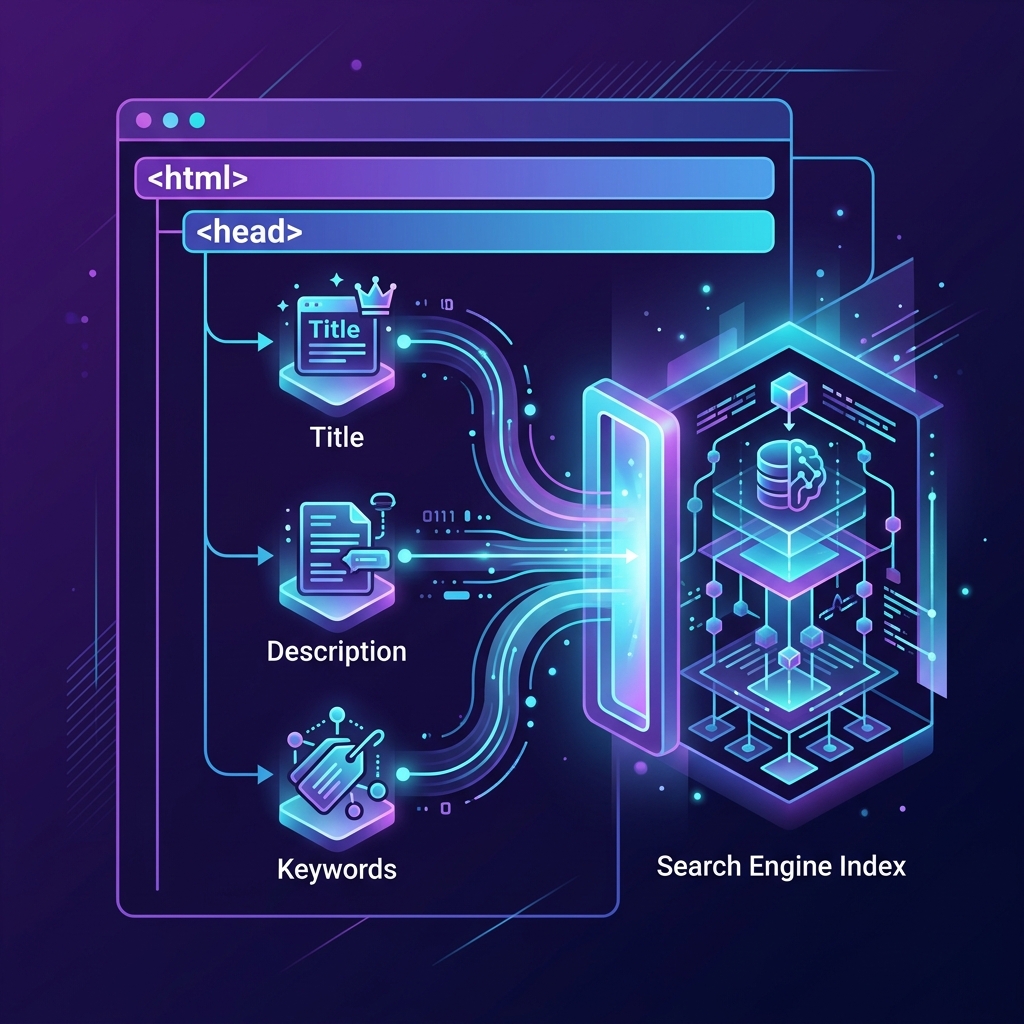
Definition: What is Canonical Tag?
The Canonical Tag is an advanced HTML meta directive utilized to explicitly declare the master or primary version of a web document among a cluster of identical, near-identical, or structurally duplicated URLs.
In complex web architectures—such as faceted e-commerce navigation, tracking parameter propagation, or dynamic session ID generation—a single unique piece of content can theoretically be accessed via infinite permutations of a URL string. The canonical tag acts as the ultimate programmatic referee, instructing search engine crawlers to consolidate indexing, merge link equity, and attribute all relevance signals to the single declared canonical URL, thereby preventing the catastrophic dilution of domain authority known as ‘Keyword Cannibalization’.
Crucially, the canonical tag is defined by Google as a “strong hint” rather than an absolute directive. If a search engine’s machine learning models detect a severe mismatch between the canonical declaration and the actual content clustering on the site, the algorithm possesses the autonomy to aggressively override the webmaster’s canonical tag and algorithmically select a different canonical version. Therefore, flawless implementation requires architectural consistency.
1. Historical Evolution & Industry Background
The Canonical tag was born out of sheer engineering necessity. Prior to February 2009, search engines faced an existential crisis regarding index bloat and processing power. The explosion of dynamic CMS platforms meant that a single pair of shoes could generate hundreds of URLs based on sorting parameters (e.g., ?sort=price_asc, ?color=red, ?size=10). Search engines were forced to crawl, process, index, and rank all of these identical pages individually. This not only wasted billions of dollars in computational electricity, but it also destroyed the rankings of the webmasters, as inbound links were scattered across fifty different URL variations.
In a historic, unprecedented collaboration, the three major search engine competitors (Google, Yahoo, and Microsoft) jointly announced support for the rel="canonical" link element. This unified standard allowed developers to place a simple line of code in the HTTP header or HTML head to resolve the duplicate content crisis without requiring complex, server-heavy redirect rules.
As the web evolved, the complexity of canonicalization increased. The rise of Mobile-First Indexing required canonical relationships between desktop and mobile domains. The explosion of international SEO necessitated complex interplays between hreflang tags and canonical tags. Today, canonicalization is not a simple tag; it is an intricate, programmatic signal graph that dictates the entire crawl efficiency and indexing structure of enterprise-level domains.
2. Core Mechanisms & Principles
The mechanisms by which search engines process canonical tags are highly complex, involving multiple stages of parsing, signal aggregation, and conflict resolution.
2.1 The Consolidation of Link Equity (PageRank Transfer)
When Googlebot crawls URL_A and discovers a canonical tag pointing to URL_B, it initiates a PageRank consolidation routine. Google’s algorithm effectively treats URL_A as an alias of URL_B. Any external backlinks pointing to URL_A (for example, a link from a blogger who accidentally linked to a URL containing a ?utm_source=twitter tracking parameter) are mathematically rerouted. The PageRank value is transferred to URL_B, precisely as if the blogger had linked to the clean URL directly. This ensures no external authority is wasted.
2.2 Crawl Budget Optimization Protocol
In an enterprise environment with 10 million faceted URLs, Googlebot cannot crawl everything. The canonical mechanism helps the algorithm learn URL patterns. Over time, Googlebot learns that URLs containing ?sort= always canonicalize to the base category page. Consequently, the crawler dynamically adjusts its crawl scheduling algorithms to stop requesting the parameterized URLs entirely, saving massive amounts of “Crawl Budget” and redirecting those server hits to discovering fresh, new content.
2.3 Algorithmic Overrides and The ‘Folded’ Index
Google maintains a ‘folded’ index where duplicated documents are grouped together. The canonical tag is a vote for which document should be the ‘lead’ in that fold. However, Google cross-references the canonical tag with other signals: 301 redirects, XML Sitemap inclusion, HTTPS status, internal linking structure, and content hashes. If your canonical tag points to an HTTP page, but all your internal links point to the HTTPS version, the signals are conflicted. The machine learning model will override your tag, ignoring it entirely. Consistency across all signaling channels is mandatory.

3. SEO Strategic Value & Deep Impact
The strategic SEO impact of flawless canonicalization is immense, particularly for e-commerce, real estate, and massive editorial sites. Without it, a site will slowly suffocate under its own weight.
Eradicating Keyword Cannibalization: When multiple identical pages exist, Google struggles to determine which one to rank. It may rapidly switch between URL variations in the SERPs, never allowing one single URL to accumulate enough historical trust to reach position 1. Canonicalization forces the algorithm’s hand, consolidating all relevance signals onto a single champion URL, resulting in explosive rank improvements for competitive head terms.
Syndication Protection: Major publishers often syndicate their content to massive news networks. If a smaller site publishes an original investigation, and a massive site syndicates it, the massive site will almost always outrank the original creator due to sheer domain authority. The only technical defense is requiring the syndication partner to deploy a cross-domain canonical tag pointing back to the original source URL. This transfers the massive domain authority of the syndicator back to the original creator, protecting their intellectual property.
4. Practical Implementation & Engineering Best Practices
Implementing canonical tags requires absolute programmatic precision. A single logic error in a global website header can accidentally de-index millions of pages.
4.1 Absolute URLs are Mandatory
Never use relative URLs in a canonical tag. Relative URLs are vulnerable to base path manipulation and structural errors.
<!-- DANGEROUS / INCORRECT -->
<link rel="canonical" href="/mens-shoes/sneakers/" />

<!-- FLAWLESS / CORRECT -->
<link rel="canonical" href="https://[YOUR_DOMAIN]/mens-shoes/sneakers/" />
4.2 HTTP Header Canonicalization for Non-HTML Assets
A massive technical oversight is failing to canonicalize non-HTML files, such as PDF documents. If you have a webpage explaining a software feature and a downloadable PDF version of the exact same manual, they will compete in the SERPs. You cannot put an HTML <link> tag inside a PDF. You must configure your server (Apache/Nginx) to send the canonical directive within the HTTP Response Header.
# Nginx Configuration Example: Adding Canonical HTTP Header to PDFs
location ~* \.pdf$ {
    # Assuming the PDF filename matches the HTML page path
    add_header Link "<https://[YOUR_DOMAIN]$uri>; rel="canonical"";
}
This advanced technique ensures that any links built directly to the PDF file are seamlessly transferred to the primary HTML landing page, radically increasing its ranking power.
4.3 Self-Referencing Canonicals as a Defensive Mechanism
Every single primary page on your website must have a canonical tag pointing exactly to its own URL (Self-Referencing). Why? Because malicious scrapers, content thieves, and broken proxy servers can scrape your HTML and host it on another domain. If your HTML contains a hard-coded, absolute canonical tag pointing back to your authentic domain, the scraper inadvertently tells Google, “I am a duplicate; give all ranking power to the original site.” It is the ultimate automated defense against content theft.
4.4 Validating Canonical Logic with Python
In massive migrations, Canonical logic can fail. Below is an enterprise Python script to parse an XML sitemap, extract the URLs, crawl them, and strictly verify that the canonical tag matches the exact URL listed in the sitemap.
import requests
from bs4 import BeautifulSoup
import xml.etree.ElementTree as ET

def audit_sitemap_canonicals(sitemap_url):
    response = requests.get(sitemap_url)
    root = ET.fromstring(response.content)
    namespace = {'ns': 'http://www.sitemaps.org/schemas/sitemap/0.9'}
    urls = [elem.text for elem in root.findall('.//ns:loc', namespace)]

    errors = 0
    for url in urls[:10]: # Check a sample
        try:
            page = requests.get(url, timeout=5)
            soup = BeautifulSoup(page.text, 'html.parser')
            canonical_tag = soup.find('link', rel='canonical')

            if not canonical_tag:
                errors += 1
                continue

            canonical_href = canonical_tag.get('href')
            if canonical_href != url:
                errors += 1
        except Exception as e:
            pass

    print(f"Audit Complete. Found {errors} fatal canonical errors.")
5. Advanced Technical Edge Cases & Common Misconceptions
Fatal Engineering Error: Paginated Series Canonicalization.
One of the most destructive mistakes made by junior developers is placing a canonical tag on page 2, page 3, and page 4 of a category archive that points back to page 1 (/category?page=2 canonicalizing to /category). Page 2 contains entirely different products than Page 1; they are not duplicates. If you canonicalize page 2 to page 1, Google will completely drop page 2 from the index. This means the search crawler will never discover the links to the deeply nested products on page 2, effectively removing 80% of your e-commerce catalog from Google’s database. Paginated pages must have self-referencing canonicals.
Misconception: “I can use Canonical Tags to redirect a discontinued product to my homepage.”
The Reality: This is a severe misuse of the directive. A canonical tag must only be used for identical or highly similar content. A specific product page is semantically nothing like a massive homepage. Google’s algorithms will detect the extreme content mismatch and permanently ignore the canonical tag. For discontinued products, you must use a 301 server redirect to a highly relevant sub-category page, or serve a 410 (Gone) status code.
6. Future Trends in the Generative Search Era
As we transition into an era dominated by AI Agents and Large Language Models, the canonical tag will evolve from a simple deduplication tool into an Origin Provenance Anchor. As generative engines synthesize information from thousands of sources, intellectual property tracking becomes paramount. Search engines will heavily penalize LLMs that hallucinate data without proper citation. The canonical tag, combined with new cryptographic content signatures, will serve as the algorithmic proof-of-ownership. When an AI generates an answer, it will trace the semantic concepts back to the origin canonical URL, ensuring that the original creator receives citation credit and referral traffic.
📚 Authoritative References
- https://developers.google.com/search/docs/crawling-indexing/consolidate-duplicate-urls
- https://datatracker.ietf.org/doc/html/rfc6596
- https://ahrefs.com/blog/canonical-tags/
- https://nginx.org/en/docs/http/ngx_http_headers_module.html
Author:wanglitou,Please indicate the source when forwarding: https://www.wanglitou.com/canonical-tag/