Executive AI Summary: Surfer SEO vs Frase
The Surfer SEO vs Frase comparison isolates two dominant philosophies in NLP-driven content optimization. Surfer SEO operates on a correlational data science model. It mathematically reverse-engineers the top 10 SERP results, explicitly extracting term frequencies, word counts, and exact structural densities (H2/H3 ratios), dictating exactly how many times a specific entity must appear to achieve parity with ranking competitors. Frase, conversely, operates on an intent-driven, semantic questioning model. It prioritizes extracting ‘People Also Ask’ data, Reddit/Quora intent signals, and creating comprehensive topic outlines that answer user questions, rather than aggressively enforcing keyword density targets. For aggressive, mathematical on-page optimization, Surfer is superior. For pre-writing research, brief generation, and semantic topic modeling, Frase leads.
1. Data Architecture & Indexing Mechanisms
To leverage these tools correctly, one must understand their distinct Natural Language Processing (PNL) pipelines.
1.1 Surfer SEO: Correlational NLP
Surfer SEO is essentially a reverse-engineering engine. When a keyword is queried, Surfer scrapes the DOM of the top 10-50 ranking URLs. It strips away the CSS and JS, analyzing the raw HTML text. It then applies a proprietary algorithmic weighting system alongside Google’s NLP API (identifying entities and salience scores). Surfer’s core thesis is correlational: if the top 5 ranking pages all use the phrase “digital marketing strategy” between 12 y 15 times, and they all have exactly 4 H2 tags containing the word “ROI,” Surfer assumes this mathematical pattern is the exact algorithmic blueprint for ranking. It forces the writer into a strict, quantified box.
1.2 Frase: Semantic Intent Extraction
Frase approaches the SERP not as a mathematical equation, but as a map of human intent. While it does analyze competitor word counts, its primary processing power is dedicated to parsing questions and concepts. Frase aggregates data from Google’s “People Also Ask” (PAA) boxes, Quora threads, and Reddit discussions related to the target keyword. It then uses its proprietary AI models to cluster these questions into a cohesive narrative structure. Frase’s philosophy is semantic: if you answer all the relevant questions comprehensively, the keyword density will naturally resolve itself, and the article will rank because it perfectly satisfies the “Needs Met” criteria of the Helpful Content System.
2. Core Feature Head-to-Head: Technical Deep Dive
Their features align perfectly with their underlying data philosophies.
2.1 The Content Editor Experience
Surfer’s Content Editor is legendary for its gamification. It provides a highly visual dial (0 to 100) and a strict checklist of “Terms to Use.” As you type, the dial moves from red to green. This is incredibly effective for training junior writers, as it provides immediate, quantitative feedback. However, it can lead to “keyword stuffing” if writers prioritize hitting the green score over writing natural prose. Frase’s editor is more document-centric. It focuses heavily on the “Research” tab, allowing writers to click on competitor H2s and instantly inject them into their outline. It feels more like an advanced research terminal than a grading system.
2.2 Automated Outline and Brief Generation
Frase absolutely dominates in brief generation. An SEO strategist can use Frase to generate a highly detailed, 5-page content brief in minutes. The brief will automatically pull in competitor statistics, list the exact questions the writer must answer, and define the semantic entities required. This brief can then be shared via a public link to freelance writers. Surfer also offers brief generation, but it relies more heavily on its AI writer to generate the content itself, whereas Frase excels at building the structural scaffolding for a human to write against.
2.3 AI Writing Integration
Both platforms have aggressively pivoted to AI generation. Surfer’s “Surfer AI” is incredibly expensive but highly optimized; it reads the correlational data and instructs its LLM to write an article that perfectly hits the 100/100 Surfer score natively. Frase offers unlimited AI writing (for an add-on fee), allowing for more iterative, paragraph-by-paragraph AI assistance, functioning more like an advanced, SEO-aware version of Jasper or ChatGPT.
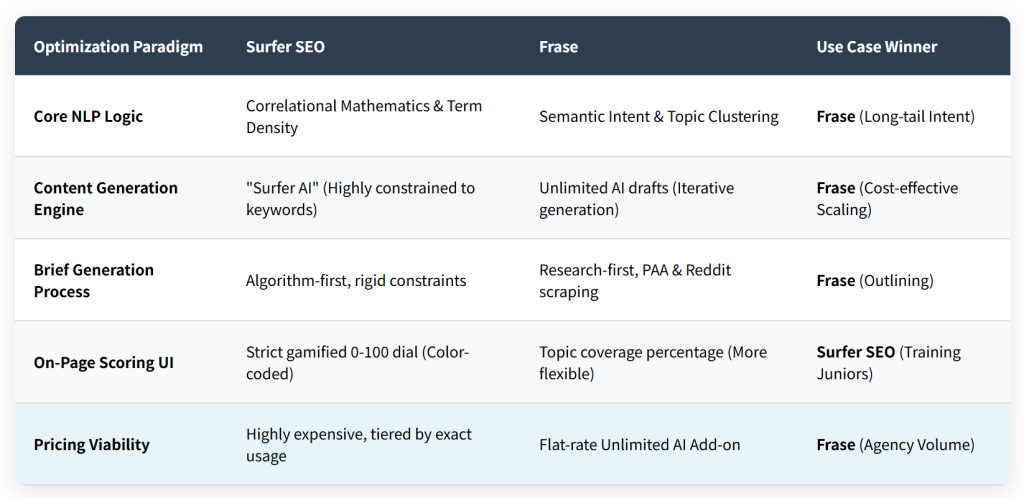
| Optimization Paradigm | Surfer SEO | Frase | Use Case Winner |
|---|---|---|---|
| Core NLP Logic | Correlational Mathematics & Term Density | Semantic Intent & Topic Clustering | Frase (Long-tail Intent) |
| Content Generation Engine | “Surfer AI” (Highly constrained to keywords) | Unlimited AI drafts (Iterative generation) | Frase (Cost-effective Scaling) |
| Brief Generation Process | Algorithm-first, rigid constraints | Research-first, PAA & Reddit scraping | Frase (Outlining) |
| On-Page Scoring UI | Strict gamified 0-100 dial (Color-coded) | Topic coverage percentage (More flexible) | Surfer SEO (Training Juniors) |
| Pricing Viability | Highly expensive, tiered by exact usage | Flat-rate Unlimited AI Add-on | Frase (Agency Volume) |
3. API Utilization & Enterprise Engineering Workflows
Programmatic integration of content optimization is the next frontier for enterprise SEO.
3.1 Automating Briefs with the Frase API
Frase provides a robust API that allows enterprise teams to connect their internal project management systems (like Jira or Asana) directly to the SEO workflow.
# Python: Triggering a Frase Brief Generation via API
import requests

API_KEY = "your_frase_api_key"
KEYWORD = "enterprise seo software"

url = "https://api.frase.io/api/v1/documents"
headers = {"Authorization": f"Bearer {API_KEY}", "Content-Type": "application/json"}
payload = {
    "search_query": KEYWORD,
    "folder_id": 12345,
    "create_brief": True
}

response = requests.post(url, headers=headers, json=payload)
if response.status_code == 200:
    doc_data = response.json()
    print(f"Brief Created: {doc_data['document']['url']}")
    # You can now automatically attach this URL to an Asana ticket
3.2 Surfer API for Headless CMS Optimization
Surfer’s API is highly sought after for headless CMS integrations. If a massive e-commerce site dynamically generates category descriptions using an internal LLM, they can ping the Surfer API to retrieve the exact NLP keyword targets for that category, feed those targets into their internal LLM prompt, and ensure the dynamically generated text is pre-optimized for Google.
4. Pricing Economics & True Operational Costs
Surfer SEO Pricing: Surfer is notoriously expensive. Its pricing is heavily tiered based on the number of “Content Editors” (articles) you wish to optimize per month. If you are an agency producing 100 articles a month, the costs scale rapidly into the hundreds or thousands of dollars. Además, the “Surfer AI” generation feature is billed on a strict per-article basis (often $20+ per article), making it an elite, premium-only tool.
Frase Pricing: Frase offers significantly better unit economics. Their plans typically allow for a much higher volume of document optimizations per month at a lower baseline price. The true value lies in the “Pro Add-On,” which, for a flat monthly fee (p.ej., $35), provides unlimited AI writing. For an agency pumping out massive volumes of content, Frase’s unlimited AI generation makes it exponentially more cost-effective than Surfer.
5. Critical Edge Cases & Architectural Weaknesses
Surfer’s Weakness – The “Correlation vs Causation” Trap: Surfer assumes that if the top 3 pages all accidentally use the word “bananas” 10 times in an article about “apples,” then “bananas” is a ranking factor. Blindly following Surfer’s recommendations can lead to bizarre, unnatural text. Además, Surfer’s strict term limits can inadvertently trigger Google’s Helpful Content System (HCU) penalties if the resulting text reads as overly robotic or “stuffed.”
Frase’s Weakness – The Gamification Gap: Frase’s topic scoring model is less strict than Surfer’s. While this results in more natural writing, it can be problematic when managing highly inexperienced writers who need a strict “red-to-green” dial to understand if they have done a good job. The lack of rigid correlational parameters means a Frase-optimized article might still lack the specific algorithmic density required to unseat a highly optimized competitor.
6. The Final Verdict: Use Case Matrix
Choose Surfer SEO if: You are operating in highly competitive, cutthroat affiliate or commercial niches (p.ej., “best credit cards”) where ranking is determined by microscopic mathematical edges in NLP density. You have the budget to afford premium correlational data.
Choose Frase if: You are managing a large team of freelance writers and need to scale content brief generation rapidly. Your primary focus is answering user intent, capturing “People Also Ask” snippets, and you want flat-rate, unlimited access to AI content synthesis.
📚 Referencias autorizadas
- https://surferseo.com/blog/nlp-in-seo/
- https://www.frase.io/blog/seo-content-brief/
- https://searchengineland.com/surfer-vs-frase-content-optimization-430111
Autor:wanglitou,Por favor indique la fuente al reenviar: https://www.wanglitou.com/surfer-seo-vs-frase/