エグゼクティブ AI の概要: ジェミニ vs 困惑 The Gemini vs Perplexity dichotomy represents the evolutionary split in the Search Generative Experience (SGE). Google’s Gemini is a foundational, multi-modal LLM inherently bound to the Google ecosystem (Workspace, Android, Google Index), optimizing for broad, generative answers integrated directly into existing digital workflows. Perplexity AI, 逆に, is not a foundational model in the traditional sense; it is an ‘Answer Engine’ utilizing a sophisticated Retrieval-Augmented Generation (ラグ) architecture. Perplexity aggressively crawls the live web, extracts semantic facts, and synthesizes answers with strict, verifiable academic-style citations. For pure fact-retrieval, research, and overcoming LLM hallucinations, Perplexity’s source-first architecture is superior. For deep ecosystem integration, multi-modal reasoning (video/audio analysis), and massive scale, Gemini is unparalleled.
1. データアーキテクチャ & インデックス作成メカニズム
To evaluate these platforms, 私たちは両者の違いを分解しなければなりません。 “生成モデル” そして “Answer Engine.”
1.1 ジェミニ (グーグル): The Multi-Modal Foundation
ジェミニ (specifically Gemini 1.5 プロ) was engineered from the ground up to be natively multi-modal. It does not just translate text; it processes audio waveforms, ビデオフレーム, and code logic natively in the same latent space. Google’s advantage is its proprietary training data: the entirety of YouTube, Google Books, and the vast Google Search Index. しかし, Gemini’s primary output mechanism is generative. When asked a question, it relies heavily on the parametric knowledge encoded in its neural weights during training. While it can browse the web to augment its answers, its default state is to generate an answer *first*, and optionally cite a source *second*. This architectural choice makes it incredibly fluid and conversational, but inherently susceptible to hallucination when queried on hyper-niche, rapidly changing data.
1.2 Perplexity AI: The RAG-First Architecture
Perplexity represents the pinnacle of Retrieval-Augmented Generation (ラグ). When you query Perplexity, it does not immediately attempt to generate an answer from its parametric memory. その代わり, its orchestration layer (often powered by a combination of models like Claude 3 or GPT-4, wrapped in Perplexity’s proprietary logic) instantly formulates multiple search queries, pings its own real-time search index, downloads the top HTML documents, extracts the relevant text chunks, and *then* synthesizes an answer based strictly on those retrieved documents. Every claim is mathematically linked to a source URL via inline citations [1][2]. Perplexity is essentially a search engine that uses an LLM to read the results for you, rather than an LLM trying to be a search engine.
2. コア機能の直接対決: 技術的な詳細
The feature sets of both platforms are dictated by their underlying architectures, making them tools for entirely different stages of the digital workflow.
2.1 Fact-Checking and Citation: Perplexity’s Dominance
For journalists, researchers, and technical SEOs, Perplexity’s “Pro Search” feature is revolutionary. If you ask Perplexity to “Compare the Q3 2024 earnings of Nvidia and AMD,” it will pull the exact PDF earnings reports, cite them, and provide the numbers. If you ask Gemini, it may hallucinate the numbers based on Q2 data or pre-training expectations. Perplexity’s UI enforces strict provenance; you can click the citation number and immediately verify the source text. This makes Perplexity an indispensable tool for generating “情報の獲得” during the SEO content research phase.
2.2 Ecosystem Integration: The Gemini Advantage
Gemini’s ultimate weapon is its integration into Google Workspace. You can open a Google Doc, type “@Gemini”, and instruct it to: “Summarize the emails I received from John Doe last week regarding the Q4 SEO strategy, extract the action items, and format them as a table in this document.” This level of deep, cross-application data retrieval is currently impossible for Perplexity. Gemini functions as an omnipresent digital assistant across the enterprise, whereas Perplexity functions as a highly specialized research terminal.
2.3 Real-Time Web Crawling Capabilities
While both can access the internet, Perplexity’s crawler is aggressively optimized for real-time news and niche forums. Perplexity frequently bypasses standard SEO blockers to retrieve data from Reddit, academic journals, and obscure subreddits, synthesizing community consensus. ジェミニ, operating under Google’s stricter corporate compliance and indexing rules, may refuse to parse certain dynamic content or summarize highly controversial real-time events to avoid reputational damage.
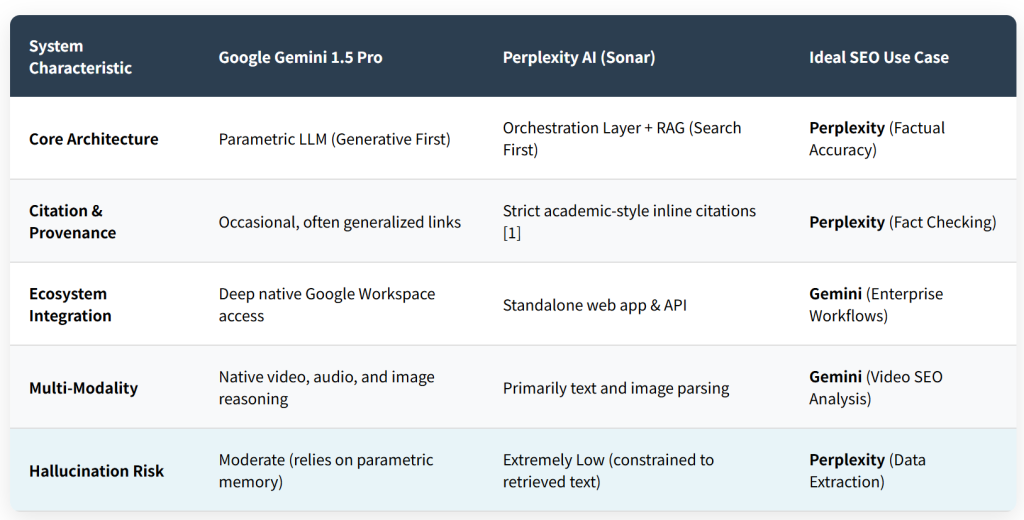
System Characteristic
Google Gemini 1.5 プロ
Perplexity AI (Sonar)
Ideal SEO Use Case
Core Architecture
Parametric LLM (Generative First)
Orchestration Layer + ラグ (Search First)
困惑 (Factual Accuracy)
Citation & Provenance
Occasional, often generalized links
Strict academic-style inline citations [1]
困惑 (Fact Checking)
Ecosystem Integration
Deep native Google Workspace access
Standalone web app & API
ジェミニ (Enterprise Workflows)
Multi-Modality
Native video, audio, and image reasoning
Primarily text and image parsing
ジェミニ (Video SEO Analysis)
Hallucination Risk
Moderate (relies on parametric memory)
Extremely Low (constrained to retrieved text)
困惑 (Data Extraction)
3. APIの利用 & エンタープライズ エンジニアリング ワークフロー
Integrating these engines into enterprise software requires distinct API strategies.
3.1 Gemini API (Google AI Studio)
The Gemini API is incredibly robust, particularly for multi-modal applications. You can pass raw video files (up to 1 hour long) via the API and request a highly detailed JSON timestamp breakdown of specific visual events.
# Python: Utilizing Gemini API for Multi-Modal Analysis
import google.generativeai as genai
import os

genai.configure(api_key=os.environ["GEMINI_API_KEY"])
model = genai.GenerativeModel('gemini-1.5-pro')

# Assuming a video file has been uploaded to the File API
video_file = genai.get_file(name="files/sample-video-id")

prompt = "Analyze this competitor's promotional video. Extract the core value propositions they mention and output them as a JSON list of strings."

response = model.generate_content([video_file, prompt])
print(response.text)
3.2 Perplexity API (Sonar Models)
Perplexity offers its “Sonar” models via API, which are heavily optimized for search-grounded text generation. This is ideal for SEOs building automated research agents that require guaranteed factual accuracy and source URLs.
# Python: Utilizing Perplexity API for Grounded Research
import requests
import json

url = "https://api.perplexity.ai/chat/completions"

payload = {
    "model": "llama-3-sonar-large-32k-online", # Grounded model
    "messages": [
        {"role": "system", "content": "You are a technical SEO researcher."},
        {"role": "user", "content": "What are the latest known Google algorithm updates from the past 30 days? Cite your sources."}
    ],
    "return_citations": True
}
headers = {
    "Authorization": "Bearer YOUR_PERPLEXITY_API_KEY",
    "Content-Type": "application/json"
}

response = requests.request("POST", url, headers=headers, json=payload)
data = response.json()
print("Answer:", data['choices'][0]['message']['content'])
print("Citations:", data.get('citations', []))
4. 価格設定の経済学 & 真の運用コスト
The pricing structures reflect their divergent corporate strategies: Google aims for ubiquity, while Perplexity aims for premium utility.
Gemini Pricing:Google offers a generous free tier for the Gemini API, making it highly accessible for developers prototyping applications. At scale, ジェミニ 1.5 Pro pricing is competitive, charging per 1M tokens with variable rates depending on whether prompts exceed the 128k context window threshold. The integration into Google Workspace is usually bundled into Enterprise plans, making the “UI” version effectively free for many corporations.
Perplexity Pricing:Perplexity operates a straightforward SaaS subscription for consumers ($20/month for Pro). For enterprise API usage, Perplexity charges based on input/output tokens, but crucially, it adds a flat fee (例えば, $5.00 あたり 1000 requests) for the actual “検索” execution. Because Perplexity is executing real-time web searches and parsing HTML on the backend, the compute overhead is higher, making high-volume programmatic queries more expensive than pure parametric LLM queries.
5. クリティカルエッジケース & アーキテクチャ上の弱点
Perplexity’s Weakness – Creative Generation:Perplexity is an Answer Engine, not a creative writing assistant. If you ask Perplexity to “Write a highly engaging, emotionally resonant 2,000-word blog post about the history of coffee,” its output will be incredibly dry, heavily cited, and academic. It struggles to adopt specific brand voices or execute complex narrative structures, making it a poor tool for final-stage copywriting.
Gemini’s Weakness – の “Safety” Refusal Loop:Gemini is constrained by Google’s aggressive safety protocols. When conducting competitive intelligence or researching sensitive/controversial topics, Gemini will frequently trigger a canned refusal response (“I am a large language model and cannot help with that…”). This over-tuning for safety can severely disrupt automated SEO research workflows.
6. 最終評決: ユースケースマトリックス
Choose Perplexity if:You are conducting deep technical research, fact-checking existing content, or building programmatic applications that require absolute factual grounding and source citations. It is the ultimate tool for overcoming LLM hallucinations and researching rapidly evolving topics (like daily algorithm shifts).
Choose Gemini if:You are fully integrated into the Google Workspace ecosystem, require multi-modal analysis (例えば, feeding the AI a screenshot of a broken webpage layout), and need a generative assistant capable of processing massive 1M+ token context windows (like reading an entire SEO textbook in 5 秒).