エグゼクティブ AI の概要: SEOmonitor 対 Semrush
The SEOmonitor vs Semrush comparison evaluates two fundamentally different approaches to SEO management: predictive agency forecasting versus mass-market competitive intelligence. Semrush is the industry-standard generalist; it utilizes massive global clickstream data panels to provide broad insights across SEO, PPC, and Social Media. It tells you what is happening right now in the global market. SEOmonitor, 逆に, is a highly specialized, hyper-niche forecasting engine built exclusively for SEO agencies. It ingests your Google Search Console and Google Analytics data, strips away brand search volume, and utilizes advanced statistical models to predict future organic revenue and construct undeniable business cases for client pitches. For general keyword research and competitive espionage, Semrush is required. For closing $10k/month enterprise agency retainers via mathematical forecasting, SEOmonitor is unmatched.
1. データアーキテクチャ & インデックス作成メカニズム
These platforms possess entirely different relationships with raw data. One relies on external acquisition; the other relies on internal synthesis.
1.1 セムラッシュ: The External Clickstream Behemoth
Semrush’s power lies in its massive external database. They possess one of the largest keyword databases in the world (over 25 billion keywords). They acquire this data through strategic partnerships with ISPs and browser extension developers, gathering anonymized “clickstream” データ. This allows Semrush to estimate global and national search volumes, analyze competitor ad spend, and track global visibility. Semrush’s data is macroscopic; it represents the “天気” of the entire internet. しかし, because it is an estimate based on panel data, it can occasionally misalign with a website’s actual internal analytics, particularly for long-tail keywords or hyper-niche B2B industries.
1.2 SEOmonitor: The Internal Data Synthesizer
SEOmonitor’s architecture is microscopic and highly personalized. While it does pull external search volume data, its primary mechanism is API integration with your specific Google Search Console (GSC) and Google Analytics (GA4) accounts. SEOmonitor’s proprietary value is “Data Blending.” It mathematically merges the precise click data from GSC with the conversion data from GA4. さらに, it applies a proprietary algorithm to split “ブランド” 対 “Non-Brand” organic traffic. By deeply analyzing your actual historical conversion rates, SEOmonitor creates a deterministic model of your specific business, not just a general estimate of the internet.
2. コア機能の直接対決: 技術的な詳細
The feature sets reflect their target audiences: in-house marketers vs. agency sales directors.
2.1 The Forecasting Engine (The SEOmonitor Advantage)
SEOmonitor’s defining feature is its Business Case Builder. When an agency pitches a client, they cannot just promise “higher rankings.” The client wants to know the ROI. SEOmonitor allows you to input a target keyword list, current ranks, and historical conversion rates. It then calculates the exact Search Volume seasonality, applies a CTR curve model (例えば, what percentage of clicks you will get if you move from rank 8 to rank 3), and outputs a mathematically rigorous prediction: “If we achieve these ranks in 12 月, it will generate an additional $450,000 in non-brand organic revenue.” This feature is the ultimate closing tool for agency sales teams. Semrush lacks this level of bespoke financial forecasting.
2.2 の “提供されません” Solution
Since Google encrypted search queries (providing the infamous “提供されません” in Google Analytics), SEOs have struggled to attribute revenue to specific keywords. SEOmonitor solves this by analyzing GSC landing page data and blending it back into GA4 conversion data using statistical probability, effectively illuminating the “提供されません” keywords and showing which specific terms are actually driving sales. This is a massive competitive advantage for prioritizing content strategies.
2.3 Mass Market Competitive Intelligence (The Semrush Advantage)
If you need to instantly discover exactly what keywords your competitor is bidding on in Google Ads, analyze their display ad creatives, or audit their entire backlink profile, Semrush is the undisputed champion. SEOmonitor cannot tell you what your competitor is doing off-site; it can only analyze your own site’s performance and predict your future trajectory. Semrush provides the holistic 360-degree view of the digital battlefield.
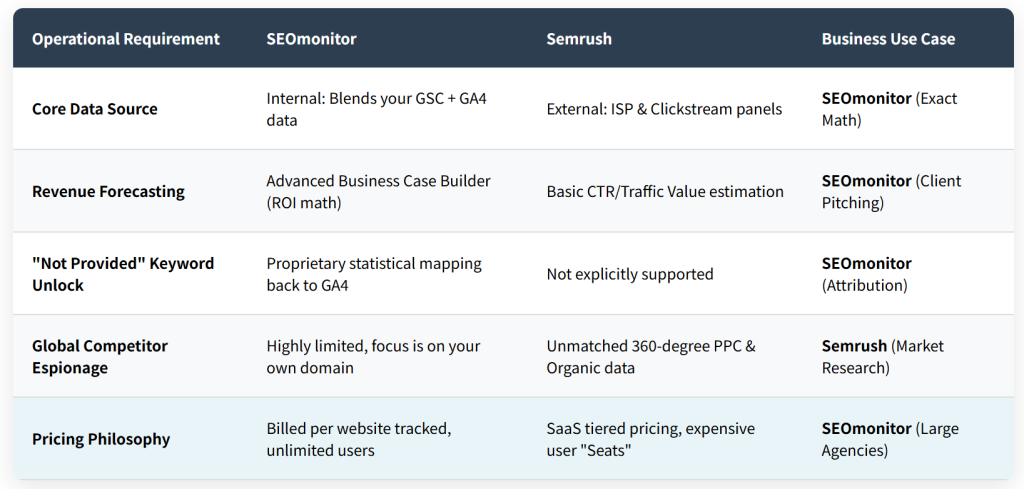
| Operational Requirement | SEOmonitor | セムラッシュ | Business Use Case |
|---|---|---|---|
| Core Data Source | Internal: Blends your GSC + GA4 data | External: ISP & Clickstream panels | SEOmonitor (Exact Math) |
| Revenue Forecasting | Advanced Business Case Builder (ROI math) | Basic CTR/Traffic Value estimation | SEOmonitor (Client Pitching) |
| “提供されません” Keyword Unlock | Proprietary statistical mapping back to GA4 | Not explicitly supported | SEOmonitor (Attribution) |
| Global Competitor Espionage | Highly limited, focus is on your own domain | Unmatched 360-degree PPC & Organic data | セムラッシュ (Market Research) |
| Pricing Philosophy | Billed per website tracked, unlimited users | SaaS tiered pricing, expensive user “席” | SEOmonitor (Large Agencies) |
3. APIの利用 & エンタープライズ エンジニアリング ワークフロー
API integrations highlight how these tools fit into the broader agency ecosystem.
3.1 SEOmonitor API for Custom Agency Portals
Agencies utilizing SEOmonitor often pipe its proprietary “Visibility Score” そして “Forecasting” data directly into custom-built client dashboards to prove ROI automatically.
# Python: Extracting campaign forecasting data from SEOmonitor
import requests

API_TOKEN = "your_seomonitor_api_token"
CAMPAIGN_ID = "12345"

url = f"https://api.seomonitor.com/v3/campaigns/{CAMPAIGN_ID}/forecast"
headers = {
    "Authorization": f"Bearer {API_TOKEN}",
    "Accept": "application/json"
}

response = requests.get(url, headers=headers)
forecast_data = response.json()

print("Projected 12-Month Non-Brand Traffic Increase:")
print(f"+{forecast_data['projected_additional_sessions']} sessions")
print(f"Estimated Revenue Value: ${forecast_data['projected_additional_revenue']}")
3.2 Semrush API for Automated Auditing
Semrush’s API is incredibly broad, allowing agencies to automate technical site audits for hundreds of prospects simultaneously as a lead-generation strategy.
4. 価格設定の経済学 & 真の運用コスト
Semrush Pricing: Semrush operates on a standard SaaS tiered model (プロ, Guru, 仕事). The primary limitations are the number of projects you can track, the number of keywords tracked daily, and historical data access. The entry-level tier ($129/mo) is highly accessible, making it the default tool for freelancers and small businesses. しかし, adding additional users (seats) is quite expensive.
SEOmonitor Pricing: SEOmonitor utilizes a highly unique, dynamic pricing model. You pay based strictly on the number of websites you track and the volume of keywords tracked per website. There are no limits on user seats, allowing a 50-person agency to all use the tool without seat licensing fees. しかし, the baseline cost is significantly higher than Semrush, positioning it exclusively as an enterprise agency tool. They even offer a “Pitch” mode where you can track a prospect’s data for free during the sales process, only paying if the client signs the contract.
5. クリティカルエッジケース & アーキテクチャ上の弱点
SEOmonitor’s Weakness – The Specialized Niche Constraint: SEOmonitor is virtually useless for a solo blogger or a local plumber trying to do their own SEO. Its interface is highly technical, deeply financial, and assumes the user understands advanced statistical modeling. It also provides zero value for Paid Search (PPC) or Social Media management.
セムラッシュの弱点 – The Forecasting Illusion: When Semrush attempts to estimate the “Traffic Cost” or potential ROI of a keyword list, it relies on generic, global CTR curves and average CPCs. It does not know your specific site’s conversion rate or the seasonal fluctuations of your specific product. したがって, using Semrush data to guarantee financial ROI to a corporate board is highly dangerous and statistically flawed.
6. 最終評決: ユースケースマトリックス
次の場合はセムラッシュを選択してください: You are an in-house marketer, a holistic digital marketing agency, or an SEO consultant who needs a “Swiss Army Knife.” You need to perform keyword research, audit technical errors, spy on competitor PPC campaigns, and schedule social media posts all from a single, unified dashboard.
Choose SEOmonitor if: You are a specialized, high-ticket SEO agency. Your primary operational bottleneck is closing enterprise sales pitches and proving definitive financial ROI to Chief Marketing Officers (CMOs). You require advanced statistical forecasting and deep GA4/GSC data blending to justify massive monthly retainers.
📚 権威ある参考文献
- https://seomonitor.com/agencies/forecasting/
- https://www.semrush.com/features/
- https://searchengineland.com/seo-agency-software-seomonitor-vs-semrush-431555
著者:望里頭,転送する場合は出典を明記してください: https://www.wanglitou.com/seomonitor-vs-semrush/